
Before deciding on a heating system, it is wise to understand how it works. IR heating differs from classic heating systems in one key principle: it does not heat the air, but surfaces. This seemingly small difference has significant consequences in practice – for comfort, for energy consumption, and for long-term costs.
IR heating works by IR panels emitting infrared radiant energy, which directly heats objects and walls in the room instead of the air. When these surfaces heat up, they radiate heat back into the room. The result is pleasant, even heat from floor to ceiling, without air circulation and without noise.
Heat is transferred in three ways:
IR heating uses the third principle – radiation.
IR panels emit electromagnetic waves in the long-wave infrared spectrum, called IR-C. This radiation travels through the air without loss – just as solar heat travels through space.
When IR radiation reaches a solid surface – floor, walls, furniture, or a person – it is absorbed and converted into heat.
Therefore, the air is not heated directly. It is heated indirectly, through the heated surfaces in the room. Since there is no need to heat large volumes of air, energy is used more efficiently – where you actually need it.
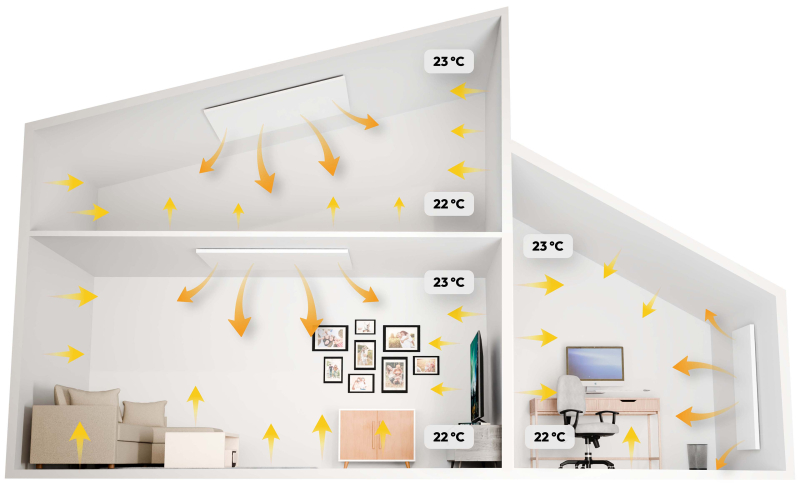
Classic heating systems – radiators, underfloor heating, pellet stoves – heat the air by convection. Warm air rises towards the ceiling, while cold air remains near the floor. The result is a temperature difference between the floor and the ceiling of 5–7 °C and constant air circulation, which carries dust, mites, and bacteria.
With IR heating, this difference is only 1–2 °C. Heat is evenly distributed from floor to ceiling, because heated surfaces – not the air – radiate heat in all directions.
One of the most common remarks from our customers is precisely this: »Nobody believes we don't have underfloor heating – the floors are warm.« This is because the radiant heat from IR panels directly reaches the floor surfaces and heats them, something conventional convection heating without floor pipes cannot achieve.
An IR panel is an electrical device with no moving parts. Electrical energy is converted into infrared radiant energy in the panel's surface – with an efficiency of 95 to 98% for Ekosen IR panels. Losses are minimal because there are no pipes, ducts, or heat exchangers where energy would be lost 'along the way'.
Ekosen IR panels emit heat at a wide angle, ensuring uniform coverage of the space. The surface temperature of the panel is 80–95 °C, which is sufficient for effective IR radiation, while not posing a danger upon accidental touch (unlike some heaters that have a surface temperature of 200+ °C).
In most cases, ceiling mounting is optimal. The reason is geometric: the distance between the ceiling and the floor is shorter than the distance between opposite walls, which means that IR radiation reaches the floor at a more suitable angle and with fewer heat losses. Additionally, ceiling mounting ensures that the IR panel cannot be blocked by furniture.
The optimal ceiling height for ceiling mounting is between 2.2 and 3.5 m. Standard residential heights are therefore ideal. For heights above 3.5 m – often in older houses, commercial premises, or industrial facilities – a precise power calculation is required, as the IR radiation must travel a greater distance to the floor and walls.
This does not mean that IR heating does not work in high spaces; it only means that higher-power panels or a greater number of panels are needed.
Wall mounting of IR panels is suitable in specific situations – for example, in a bathroom above a mirror or in a hallway where ceiling mounting is impractical. The basic rule for wall mounting: the IR panel must not be pointed directly at window surfaces, as this results in greater heat losses.
Furniture and objects in front of the panel must be at least 80 cm away.
An IR panel by itself operates simply – on/off. But when heating an entire home, it's crucial when and for how long each IR panel is switched on.
This is where regulation comes in.
Standard Wi-Fi thermostats are not adapted for IR heating, as they operate with larger temperature delays – they switch on only when the room has already cooled too much, and switch off when it's already overheated. These constant temperature fluctuations reduce comfort and cause unnecessary energy consumption.
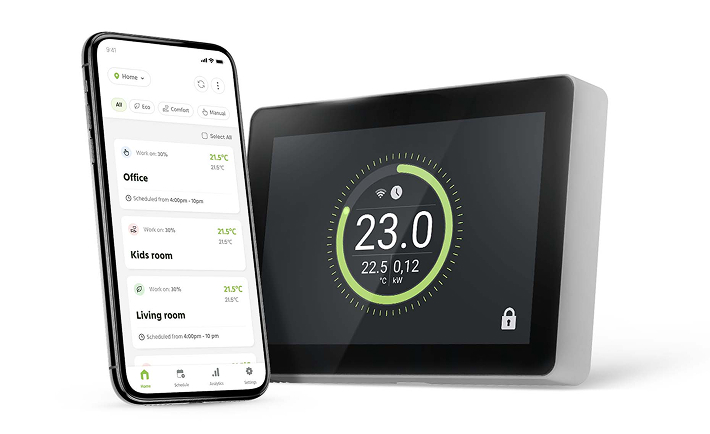
The IR Sun regulator, however, was developed exclusively for IR systems and operates responsively: it precisely and continuously dispenses heat, without unnecessary temperature jumps. The practical result is up to 25% lower energy consumption compared to a standard thermostat, with significantly greater thermal comfort.
Ekosen IR panels are designed for maximum efficiency, operating in real conditions for an average of only 3 to 5 hours a day. Such low consumption is not a coincidence, but the result of advanced technology and the physical process of accumulation.
Air is a poor heat accumulator and cools quickly when doors are opened. IR panels, however, deeply heat walls and floors, which retain heat significantly longer and radiate it back into the room long after the system is turned off.
In central heating systems, some energy is lost in pipe distribution lines before it even reaches the radiator. With IR panels, this is not the case – energy is converted directly into heat in the room where you need it.
With the IR Sun regulator, you heat each room according to its own schedule and only when you are actually using it. The system maintains a constant temperature with smart micro-adjustments, which is significantly more economical than constantly cooling down and reheating rooms.
Maximum savings occur when the system thoroughly dries out the walls, as dry walls are better insulators. Once the building reaches this thermal balance, energy consumption drops drastically, and your home begins to fully utilize the benefits of radiant heat.
Every building is specific, which is why our consultants prepare a free energy calculation that accurately predicts the system's operation in your home. Start with real data.